Clinical labs: the missing piece for healthcare interoperability in Chile
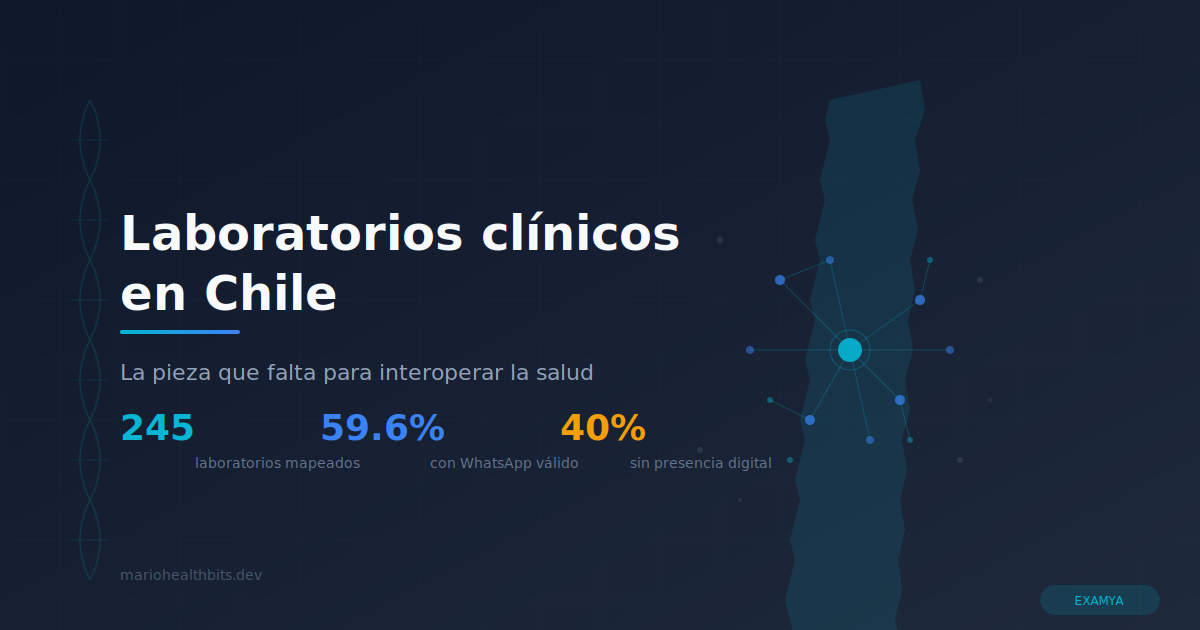
We mapped 245 clinical labs from Arica to Punta Arenas. Four out of ten lack a functional digital presence. Law 21.668 will force them to interoperate in 2026. Here are the ground-level data.
Mario Inostroza
Digital health transformation in Chile tends to focus on hospitals, large clinics, and telemedicine. But there is one actor that processes millions of medical orders per year and almost never enters the conversation.
Clinical laboratories.
The problem nobody sees
Consider the typical flow. A patient leaves the doctor’s office with a lab order. That order reaches the lab via fax, the owner’s personal WhatsApp, or in person on paper. The result comes back to the doctor when it can. Sometimes days after the clinical decision was already made.
The process is manual, fragmented, and slow. And it directly impacts clinical decision-making. Conservative estimates of the cost of non-interoperability — counting duplicate tests, lost physician hours, and extended diagnostic times — quickly add up to hundreds of millions of dollars per year in Chile alone. The exact figure does not exist because the systems do not share information, and that very fact makes it impossible to measure properly.
What we found mapping 245 labs
At Examya we do not talk about digital health from a desk. We have contacted and mapped 245 clinical laboratories from Arica to Punta Arenas. Of those, we identified and validated WhatsApp contact in 146 labs (59.6% of the total).
An autonomous agent executed that discovery process through more than 100 scraping rounds, rotating strategies based on what worked in each region:
Rounds 1-25   → Google Business Profile + institutional sites
Rounds 26-60  → Regional social media (Facebook, Instagram)
Rounds 61-100 → Manual cross-reference against DEIS registry
Validation    → regex +569\d{8} + WhatsApp Business verification
Each round processed between 10 and 20 labs. The discovery rate dropped with each strategy —the easy ones show up on Google, the hard ones you have to extract from a Facebook photo from 2019— and that pattern is itself a data point.
Three findings from the mapping:
- 40% lack a functional digital presence. We defined functional digital presence as: active domain with HTTP 200 response, verifiable contact on the site, and at least one sign of update in the last 12 months. Below that threshold lie dead sites, expired domains, and Facebook pages abandoned since 2019.
- Small and mid-size labs are the most vulnerable. They have no engineering team, depend on legacy software that integrates with nothing, and receive orders through channels they cannot track or audit.
- WhatsApp is the de facto channel. Not by design, by evolution. Patients already send orders as photos, ask about prices, receive results as PDFs. The system exists, just outside any standard.
Why WhatsApp won without anyone deciding
This is the insight that surprised me the most when the mapping finished. WhatsApp is not a lab’s digital strategy. It is what remained when every other alternative failed.
Online scheduling systems are expensive and require maintenance. Proprietary apps do not get installed. Web portals do not get used. But 95% of Chilean adults open WhatsApp every day. So the lab does the only rational thing: meets the patient where they already are.
The problem is that de facto channel does not deliver what Law 21.668 will demand: traceability, standard formats, shareable structured data. It is massive adoption without data infrastructure.
What we built with that information
Shuri is the WhatsApp medical agent we built at Examya on top of this reality. It receives a photo of the lab order via WhatsApp, interprets it with OCR, validates FONASA codes, quotes prices based on the patient’s tier (A, B, C, D), and generates the digital order. All in one conversation. No paper, no calls, no queues.
The FONASA integration requires exact RUT formatting, strict validations, and copayment tier handling. When the lab delivers results, the same flow interprets, structures, and makes them available to both the patient and the requesting physician. The complete loop: order → quote → confirmation → result → delivery.
The underlying design decision is simple: we do not try to make the lab or the patient switch channels. We connect to the channel that already exists and add structure underneath.
The bet
The MINSAL regulations for Law 21.668 took effect in November 2025. The deadline has already passed for those who were going to wait. And yet, 4 out of 10 labs we mapped do not have an active domain today.
My bet: fewer than half of Chilean clinical labs will be technically ready to interoperate when enforcement begins.
The real challenge of healthcare interoperability is not technical. FHIR exists. HL7 exists. SNOMED CT exists. What is missing is for the small and mid-size lab —80% of the ecosystem— to have a way to get there without needing an internal engineering team.
The clinical laboratory is not a passive link. It is an information node with structured data from every test, patient history, and normalized results. The problem was never the information. It is how it flows.
That is the layer we are building at Examya. We do not wait for the system to fix itself. We connect it from the ground up, one lab at a time.
If you work at a clinical lab, a small clinic, or in digital health in LATAM and all of this resonates, I would love to chat.
📱 WhatsApp: +56962170366 🐦 X.com: @marioHealthBits 🌐 mariohealthbits.dev
Related reading
In this series
Chile now requires clinical record interoperability: why this changes everything for digital health
Law 21.668 mandates all healthcare providers in Chile to make clinical records interoperable. I analyze what this means technically, which standards are coming (FHIR, SNOMED CT, AIToF), and how Examya is preparing for this newly mandatory market.
In this series
FHIR + Law 21.668: How Examya Is Preparing for Chile's Mandatory Interoperability
How we're adding a FHIR layer on top of Examya's current stack (NestJS + Prisma + pgvector) to comply with Law 21.668 without rewriting anything.
In this series
FHIR DiagnosticReport: how a lab result travels back to the ordering physician
The result is ready. Now it needs to reach the physician who ordered it — no PDF, no WhatsApp, no human middleman. Here's how FHIR DiagnosticReport works and how Examya implements it.