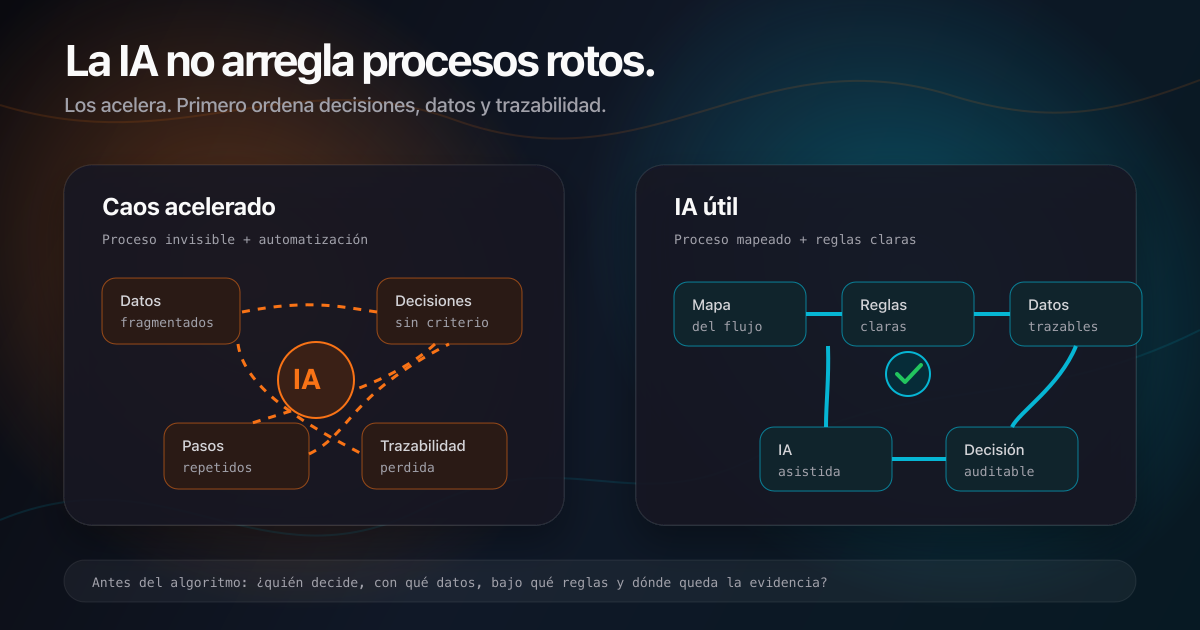
AI does not fix broken processes: it accelerates them
Before automating with AI, teams need to map decisions, data, traceability and rules. If we automate chaos, we only get faster chaos.
Mario Inostroza
AI does not fix broken processes.
It accelerates them.
That sentence may sound harsh, but in healthcare, companies, and institutions, it comes up again and again. When a workflow already depends on memory, improvisation, invisible steps and human overwork, adding an agent or a copilot does not necessarily organize the system. Many times it only makes the disorder move faster.
Before talking about advanced automation, there are more basic questions:
- Who makes the decision?
- With what information?
- Where is traceability preserved?
- Which criteria repeat over time?
- Which steps exist only because “we have always done it this way”?
If those questions do not have answers, the problem is not the model. The problem is the process.
First, see the real workflow
In practice, processes rarely work like the official diagram.
They work as a mix of spreadsheets, WhatsApp, emails, calls, operational memory and people who already know “how things are done”. That informal layer keeps the operation alive, but it also makes it fragile.
When someone proposes AI on top of that workflow, the first temptation is to automate the visible task: respond faster, summarize documents, classify cases, route requests or generate alerts.
All of that can help.
But if nobody knows exactly which decision is being supported, which data is mandatory, which criterion defines an exception or who is accountable when something fails, the automation is built on sand.
Organizing is also innovation
Sometimes the first major leap is not adding a more powerful model.
It is mapping the real workflow, removing friction and making rules explicit.
That may sound less glamorous than talking about autonomous agents, but it often has a more immediate impact:
- fewer unnecessary steps;
- less dependence on individual memory;
- fewer decisions without traceability;
- less duplicated work;
- fewer exceptions nobody can explain.
Only after that does AI start amplifying value.
Because it is no longer trying to guess an invisible process. It is supporting a designed workflow.
Automating chaos is still chaos
AI is very good at accelerating reading, classification, summarization, search, generation and coordination.
But it does not replace decision design.
If we automate a fragmented process, we get faster fragmentation. If we automate ambiguous criteria, we get ambiguity at scale. If we automate without traceability, we lose the ability to explain what happened faster.
That is why, before the algorithm, the question should be:
Does this process have clear rules, traceable data and well-designed decisions?
If the answer is no, the first job is not automation.
It is organization.
After that, AI can do what it does best: amplify a system that already has direction.
Related reading
Recommended
Human-in-the-loop is not enough: designing real oversight for medical AI
Medical AI oversight is not a doctor watching a screen. It requires authority, traceability, escalation, drift monitoring, and auditable evidence.
Similar topics
Why sub-agents work better as reviewers than concurrent writers
Throwing 5 agents to write code in parallel is a disaster. Why we inverted the pattern: 1 writer and 5 blind adversarial reviewers.
Similar topics
NEW, REVIEW, DUPLICATE: the guard that stops a content agent from writing the same post ten times
How I designed a deterministic three-state guard to prevent my content agent from repeating topics on the blog