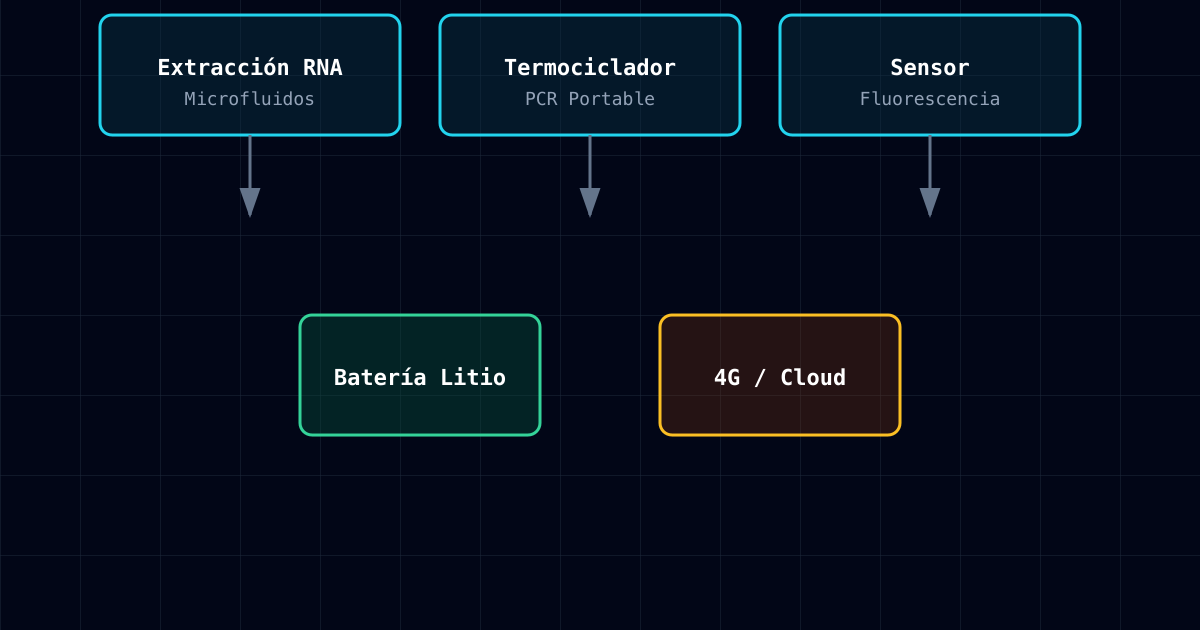
Field Engineering: How We Built a Portable Molecular Lab in Patagonia
The technical details behind BioHealth: How we packed RNA extraction, microfluidics, and 4G connectivity into a toolbox to operate in Torres del Paine.
Mario Inostroza
In the midst of the pandemic, the challenge wasn’t just clinical; it was a systems architecture problem in a hostile environment. As a medical technologist and systems architect, my job in Puerto Natales wasn’t just to take samples; it was to design a molecular diagnostic system that worked where no one else did.
I already told the story of how BioHealth was born from necessity. Today, I want to delve into the engineering behind the system.
The Challenge: Architecture in a Degraded Environment
The technical problem was simple but brutal:
- Inefficient Transport: Unacceptable results latency (>48h).
- Data Silos: Manual processes with no traceability.
- Hostile Environment: No stable infrastructure (electricity, network).
The Solution: BioHealth Portable Lab
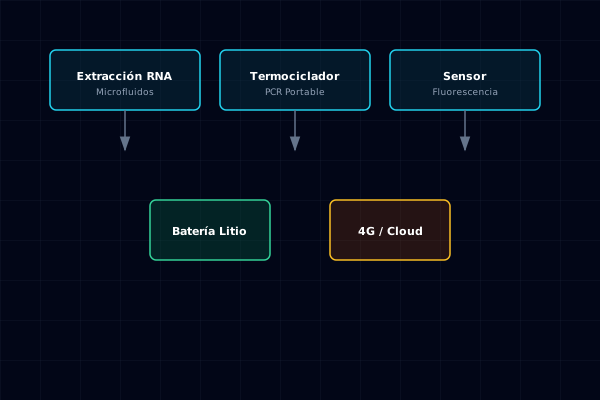
We developed a modular system that encapsulated the clinical diagnostic workflow into a compact unit:
- Extraction Module: Automated microfluidics (reducing human error).
- Thermocycler: Optimized for low power consumption.
- Traceability: 4G integration with the cloud for real-time result reporting.
Architecture Lessons for AI (and Life)
What I learned in the field—managing a lab with a lithium battery in a national park—is what I apply today to AI agent orchestration at Examya:
- Redundancy is Resilience: If the critical system (PCR) fails, the whole system fails.
- Context is King: You cannot operate if you don’t know what’s happening at the edge (4G/Cloud).
- Empathy = Technical Specification: Translating “patient anxiety” into “response time <24h”.
This wasn’t just a medical solution; it was an exercise in Screaming Architecture: the code (and hardware) must scream what problem it is solving.
Want to see how we built this? Let’s chat on WhatsApp or on X at @marioHealthBits.
Patagonia as a Living Laboratory
Puerto Natales was our accidental Silicon Valley. In a town of 20,000 with limited access, we built molecular diagnostic technology that works in extreme conditions. The lessons from Patagonia are different from Silicon Valley:
- Resilience over elegance
- Functionality over aesthetics
- Energy efficiency over infinite power
- Adaptability over perfection
What I learned here is priceless: building systems that work when everything else fails.
What’s Next: The Following Front
My experience at BioHealth prepared me for the current great challenge: interoperability in the Chilean health system. The same problems we faced with isolated samples today are the same problems the healthcare system faces with fragmented data:
- Information silos → data centralization with shared semantics
- Manual protocols → automated workflows with adaptive intelligence
- Resource scarcity → massive optimization with AI and vectors
BioHealth was my bootcamp in medical AI. Every patient processed, every result sent, every system automated built the foundations of who I am today: a systems architect for health AI.
📱 WhatsApp: +56962170366 🐦 X.com: @marioHealthBits 🌐 mariohealthbits.dev
Related reading
Similar topics
Why sub-agents work better as reviewers than concurrent writers
Throwing 5 agents to write code in parallel is a disaster. Why we inverted the pattern: 1 writer and 5 blind adversarial reviewers.
Similar topics
AI does not fix broken processes: it accelerates them
Before automating with AI, teams need to map decisions, data, traceability and rules. If we automate chaos, we only get faster chaos.
Similar topics
NEW, REVIEW, DUPLICATE: the guard that stops a content agent from writing the same post ten times
How I designed a deterministic three-state guard to prevent my content agent from repeating topics on the blog