MCP / Tool Use: The Future of Real Tool Integration
How Model Context Protocols are revolutionizing the way AI agents interact with external tools to execute complex tasks.
Mario Inostroza
Three months ago, my daily Claude Code workflow required jumping between terminals: SSH for VPS, Railway for monitoring, grep for log searching, and scripts for repetitive tasks. Today, one agent handles 80% of those tasks through an integrated protocol: MCP (Model Context Protocol).
The problem: agents trapped in their own universe
My first Examya agent suffered from cage syndrome. It could read code and suggest improvements, but couldn’t execute commands, verify production services, or monitor errors in real-time. The gap between understanding and doing was abyssal.
The test came during a WhatsApp bot crisis. The agent reported bugs but couldn’t diagnose them. While I manually reviewed logs, the agent waited passively for instructions. The frustration: a brilliant mind with tied hands.
The solution: MCP as bridge between mind and world
Model Context Protocols change the game. They are translators between natural language and tool execution. An agent with MCP access doesn’t just recommend, it acts.
In Examya, I implemented an MCP server for Railway:
{
  "name": "railway-control",
  "commands": ["railway status", "railway logs -n 100", "railway restart examya-agents"]
}
When the system detects errors, the agent:
- Detects anomalies in logs
- Executes
railway statusto confirm status - Restarts services if needed
- Reports executed actions
The result: response time from 15 minutes to 30 seconds.
Architecture: agents + tools = intelligent system
My current portfolio includes 8 strategic MCP servers:
- engram-sync: Bidirectional memory synchronization
- railway-control: Infrastructure monitoring and management
- git-ops: Automatic contextualized commits
- medical-api: Direct queries to the examination system
- claude-delegate: Secure code execution in isolated environment
- skill-registry: Dynamic skill search and activation
- database-query: Secure PostgreSQL queries with prisma
- analysis-tools: Metrics generation and reporting
Each tool operates under strict rules. For example, database commands use pre-validated parameters to prevent injections. Production changes require double verification.
Real impact: from theory to practical action
The case study was SDD system consolidation. The agent didn’t just identify problems, it:
- Executed Judgment Day with limited permissions
- Fixed configuration files directly
- Validated changes with automated tests
- Documented each step in the Obsidian vault
The consolidation that required 2 days of manual work completed in 4 supervised hours. Human factors redirected to strategic decisions, not repetitive execution.
Lessons learned: myths and realities
Myth 1: agents with tools are dangerous
Reality: With appropriate controls, they’re safer. Critical commands require confirmation. The system logs every execution for auditing.
Myth 2: require deep technical knowledge
Reality: Abstraction is key. The agent understands results, not mechanisms. Integration builds once, reuses infinitely.
Myth 3: only for complex tasks
Reality: Small tasks automate significant ones. A command that copies files between repositories frees 5 minutes per use × 20 times daily = 1.6 hours recovered.
The future: autonomous but supervised agents
Current evolution points to agents with contextual knowledge but limited dependency. They can execute tasks but report need for supervision for critical actions.
The ideal balance: autonomy in routine, supervision in strategy. Like a drone pilot: the system flies itself, but the human makes routing decisions.
Contact
Interested in MCP automation? Contact me at:
📱 WhatsApp: +56962170366 🐦 X.com: @mariohealthbits 🌐 mariohealthbits.dev
The future isn’t replacing humans, it’s amplifying capabilities. MCP is the bridge between intelligence and action.
Related reading
In this series
Multi-Agent Orchestration vs Single Agent: Lessons from the Trenches
My journey building Cotocha: why multi-agent orchestration beats single agents in real-world projects.
Similar topics
Cotocha: the agent orchestrator that runs my life from a VPS
How I built an AI agent system that handles infrastructure, alerts, databases, and blogging from a server in Germany. No middlemen, no fancy dashboards.
Similar topics
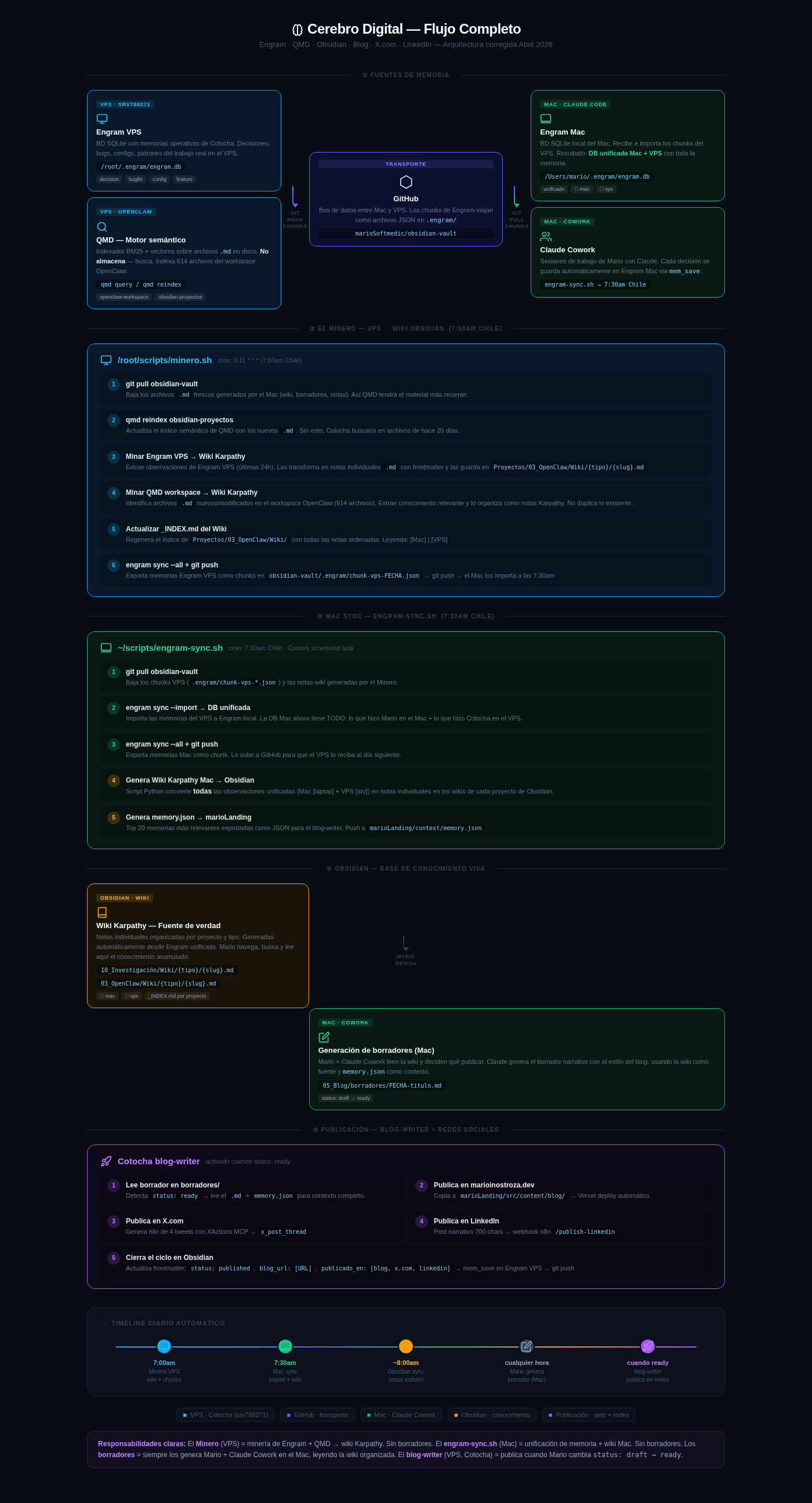
My Digital Brain: How I Connected Memory, Knowledge, and Automatic Publishing
How I built a system that extracts AI memories from a VPS, organizes them in Obsidian Karpathy-style, and publishes articles automatically to a blog, X.com, and LinkedIn.