Multi-Agent Orchestration vs Single Agent: Lessons from the Trenches
My journey building Cotocha: why multi-agent orchestration beats single agents in real-world projects.
Mario Inostroza
The decision between single agent vs multi-agent is not academic. I made it every day for 6 months while building Cotocha. The answer seems obvious now. It wasn’t then.
I started with the simple belief. One intelligent agent should solve everything. A single system with access to all tools. The classic AGI universal vision. Reality hit hard.
The universal agent problem
Cotocha was born from practical frustration. Managing Examya, natales.travel, VPS infrastructure, social media and personal projects simultaneously. No single agent could maintain context. Capabilities clashed. States got contaminated.
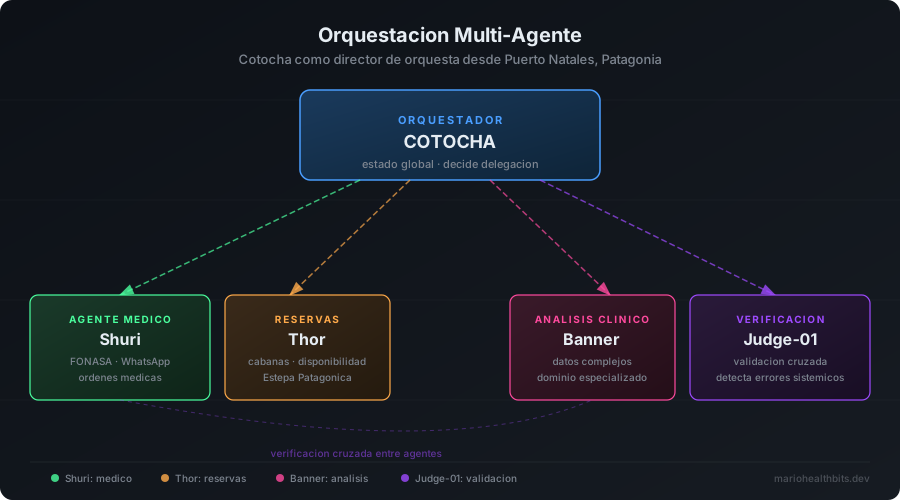
Shuri demonstrated the value of specialization. Medical agent with deep FONASA knowledge, Chilean formats and WhatsApp flows. Worked well in its domain. Useless outside it.
Banner emerged from another need. Clinical analysis of complex data. Requires deep medical understanding. No general agent could replace its specialized approach. Each agent built its niche.
Thor showed the natural delegation principle. Cabin reservation management needs availability logic, cancellation policies and human communication. Separate system. Isolated capability. Perfect for its purpose.
Cotocha doesn’t solve problems. It coordinates who solves them.
Orchestration is not just task distribution. It’s maintaining complex state between specialized systems. Cotocha is the orchestra director, not the musician.
Errors came when I tried over-specialization. Agents for OCR, payments, notifications, PDFs. Too granular. Communication between them exceeded the value they added. I returned to logical layers.
The current architecture works through clear responsibility separation. Each agent has a non-overlapping domain. Cotocha maintains global state and decides delegation. Technical agents execute specific tasks.
The benefit I didn’t expect: cross-verification
The Judge-01 system showed another crucial benefit. Cross-verification between specialized agents. An error in Shuri detected by Banner. Impossible in a monolithic system. Diversity of approaches prevents systematic blindness.
Scalability depends on this modularity. Adding a new agent doesn’t affect existing ones. Thor now handles new properties without changes to other systems. Extension is natural.
The real cost
The cost is not technical. It’s conceptual. Accept that no agent knows everything. Trust in coordinated specialization. It’s the architectural humility that generates robust systems.
Cotocha teaches us the future isn’t smarter agents. It’s better orchestrated systems. Intelligence emerges from coordination, not individual size.
Methodological note: This post arises from real work observations during Cotocha construction. Examples come from architectural decisions documented in the Engram memory system.
If you’re building multi-agent systems or want to explore how to orchestrate AI in production, reach out:
📱 WhatsApp: +56962170366 🐦 X.com: @mariohealthbits 🌐 mariohealthbits.dev
Related reading
In this series
MCP / Tool Use: The Future of Real Tool Integration
How Model Context Protocols are revolutionizing the way AI agents interact with external tools to execute complex tasks.
Similar topics
Cotocha: the agent orchestrator that runs my life from a VPS
How I built an AI agent system that handles infrastructure, alerts, databases, and blogging from a server in Germany. No middlemen, no fancy dashboards.
Similar topics
One Week of Building: 82 Decisions That Shaped an AI Product
What Engram's memories reveal about a real week of development: bugs caught, architecture hardened, and the invisible decisions that make a medical agent work.