One Week of Building: 82 Decisions That Shaped an AI Product
What Engram's memories reveal about a real week of development: bugs caught, architecture hardened, and the invisible decisions that make a medical agent work.
Mario Inostroza
Every development session leaves a trace. What usually gets lost in scattered commits and Slack messages now gets recorded in Engram: my persistent memory system. Reviewing the observations from the last 7 days, I found 82 relevant events across 8 projects. Here’s what actually happened.
The week in numbers
82 observations spanning decisions, fixed bugs, discoveries, and architecture changes. The distribution speaks for itself:
- Examya: 61 observations (74%)
- mariosoftmedic/examya: 10
- marioLanding: 4
- Examya WhatsApp hardening: 3
- Personal, Blog, OpenClaw: 3
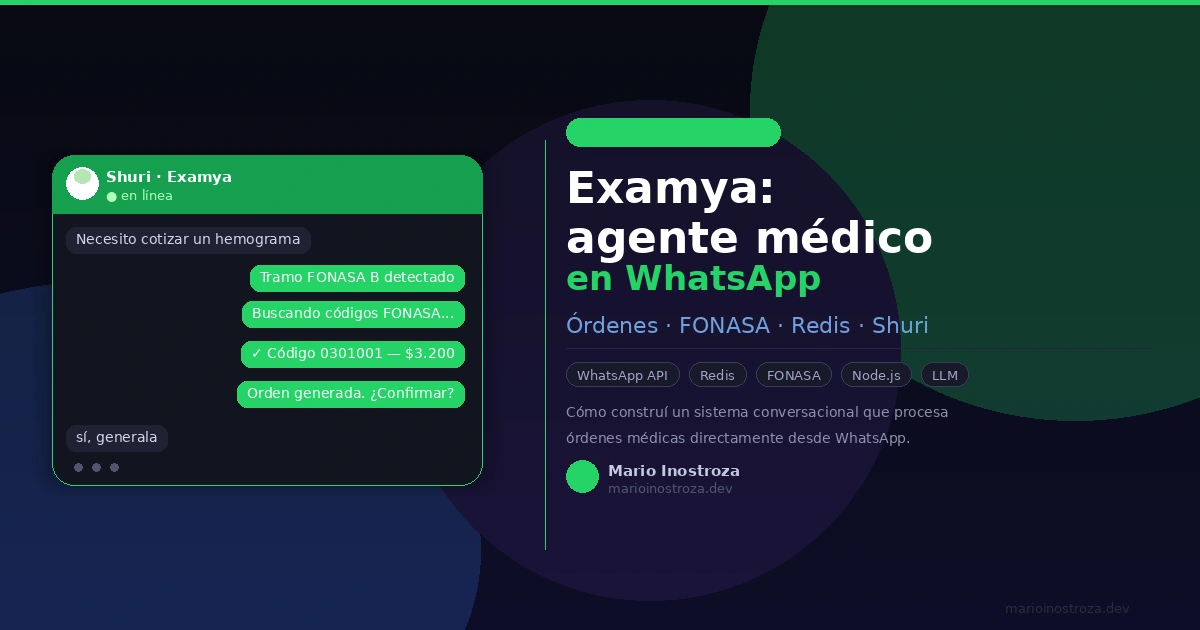
Examya dominated the week. Shuri, the medical agent that processes lab orders via WhatsApp, went through an intense stabilization phase.
Shuri: from chained bugs to hardened agent
Monday started with a raw diagnosis: 5 interconnected bugs in the WhatsApp flow. These weren’t isolated bugs. An issue in intent routing dragged errors into order confirmation, which generated incorrect prices, which led to broken payment links.
The cascade had a perverse logic. Fixing the symptom (broken payment link) was useless if the root cause (intent misrouting) remained active. The solution was to attack bottom-up: first the FSM that manages conversation states, then the handlers for each stage, and finally the pricing layer.
The key moment: Judgment Day
To verify the consolidation didn’t break anything, I ran a “Judgment Day”: three rounds of adversarial review where independent judges audit every change. Round 1 found 4 issues, including an exposed API key in a backup file. Round 2 found 1 more. Round 3: CLEAN.
It sounds excessive until you find an API key in plaintext that was about to go to production.
CENS compliance and RUT normalization
Alongside the bugs, Shuri needed to comply with Chilean health regulations (CENS). I implemented a STRICT/FLUID composition pattern for the medical agent’s handlers: strict compliance rules are separated from fluid conversation logic. Each handler knows what it can and cannot do based on regulatory context.
The patient’s RUT also went through a silent but critical fix. Normalization failed on certain formats, generating handoffs to humans that never reached their destination. A malformed string can block the entire purchase flow.
The portfolio and internationalization
While Shuri consumed most of the time, the Astro portfolio received its own refactoring. I implemented native i18n with URL-based routing for Spanish and English. Each post now has an ES and EN version, served from /blog/slug (Spanish default) and /en/blog/slug (English).
The design also changed. The site went from “basic” to something with visual impact: gradient mesh in the hero, glass cards, inline SVGs instead of emojis. The difference between a portfolio that looks templated and one that feels personal is in the CSS details.
Engram: the memory that connects everything
Friday marked a milestone: the bidirectional memory system between Mac and VPS became operational. Engram captures what I do in Claude Code (Mac) and what Cotocha executes on the VPS. Memory chunks travel via GitHub, and every morning a script compiles the Karpathy Wiki in Obsidian.
This post is the proof of concept. The 82 observations I describe here came from engram export, not from my memory. When the system works, knowledge accumulates without friction.
What I take away from this week
-
Chained bugs need systemic diagnosis, not individual patches. The technique of attacking the FSM first saved days of work.
-
Judgment Day works. Finding an exposed API key in audit round 1 justified the entire process.
-
Persistent memory changes the dynamic. Being able to search “what did I decide about WhatsApp pricing” and get the exact answer with context, without re-reading logs or chats, is a productivity multiplier.
-
Compliance isn’t a feature, it’s architecture. The STRICT/FLUID pattern separates concerns so regulatory changes don’t touch business logic.
-
Publishing in two languages doubles the work but triples the reach. The barrier to entry is low with Astro i18n, and SEO benefits enormously.
Building something with AI and want it to work in production? Let’s talk:
📱 WhatsApp: +56962170366 🐦 X.com: @mariohealthbits 🌐 mariohealthbits.dev
Related reading
In this series
Cotocha: the agent orchestrator that runs my life from a VPS
How I built an AI agent system that handles infrastructure, alerts, databases, and blogging from a server in Germany. No middlemen, no fancy dashboards.
In this series
My Digital Brain: How I Connected Memory, Knowledge, and Automatic Publishing
How I built a system that extracts AI memories from a VPS, organizes them in Obsidian Karpathy-style, and publishes articles automatically to a blog, X.com, and LinkedIn.
In this series
Bidirectional Mac-VPS Sync with Engram: the brain that never sleeps
A technical tutorial on building a bidirectional sync pipeline between a Mac, a VPS in Germany, Engram, Obsidian, and the Karpathy knowledge management method. Using Python scripts, git, and cron jobs.