100% Compliant: How we closed all 36 MINSAL verifiers in record time
Closing MINSAL accreditation (Law 21.541) isn't just about coding. Here's how we jumped from 33% to 100% compliance in a single weekend.
Mario Inostroza
Closing 36 out of 36 accreditation verifiers for Telemedicine is more than just checking items off a list. It’s ensuring that your software architecture can handle the weight of medical and legal responsibility in Chile under Law N°21,541.
At Examya, we jumped from 33% to 100% on the MINSAL compliance Scorecard in a single weekend. And I’ll be honest: it wasn’t just about writing new code. It was about technical evidence.
What no one tells you about accreditation
Many builders think that accreditation requires building new systems from scratch. The reality is that compliance is 50% engineering and 50% internal auditing.
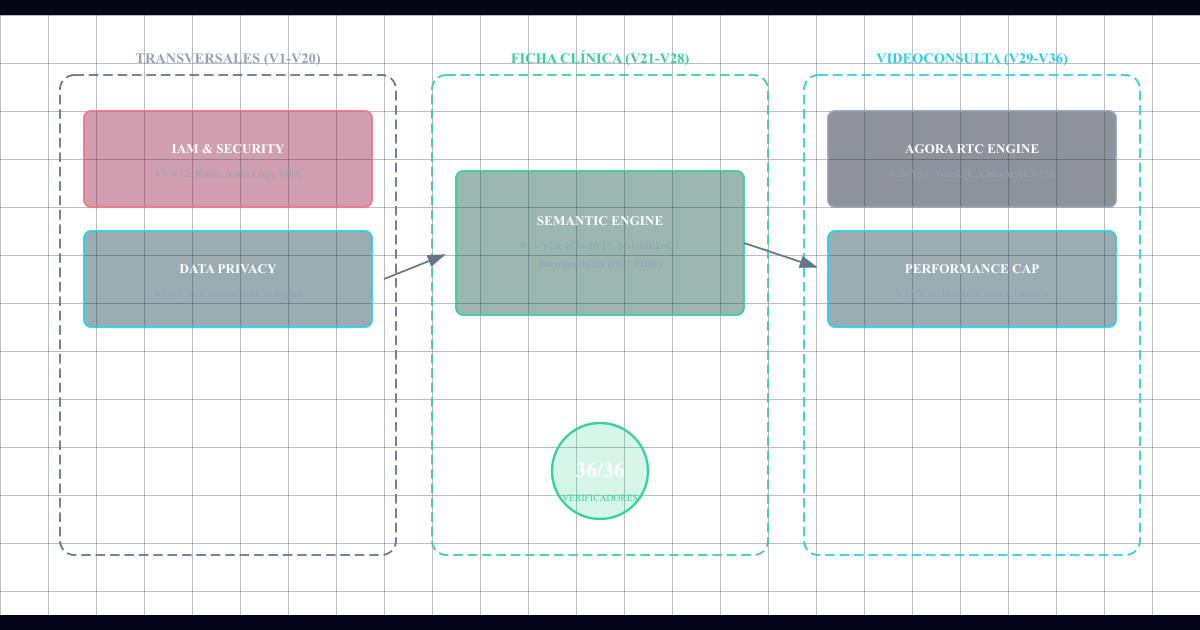
The MINSAL standard is rigorous. it divides accreditation into three fundamental pillars:
- Transversals (V1-V20): Security, auditing, and identity.
- Clinical Record (V21-V28): Real interoperability and terminologies.
- Video Consultation (V29-V36): Session stability and encryption.
The real Scorecard data
On April 10, we were at 33%. We had the pieces, but not the “trace.” By April 13, we achieved the full score.
How did we do it? We attacked the verifiers by logical groups:
- IAM and Security: PostgreSQL for immutable audit logs.
- Interoperability: Mapping to HL7 FHIR (SNOMED-CT and ICD-10/11).
- RTC Infrastructure: AES-256 encryption in Agora with VP8 codecs.
What we built (and what was already there)
A concrete example was verifier V12 (idle timeout). We already had a useIdleTimeout hook working on the frontend, with 7 out of 7 unit tests passing. However, it was marked as PARTIAL because we lacked the formal documentation to prove its behavior to the auditor.
// apps/web/src/hooks/useIdleTimeout.ts
// This hook was already saving sessions, but technical evidence was what closed V12.
export const useIdleTimeout = (timeoutMs: number, onTimeout: () => void) => {
  useEffect(() => {
    const timer = setTimeout(onTimeout, timeoutMs);
    return () => clearTimeout(timer);
  }, [timeoutMs, onTimeout]);
};
For the video consultation group (V32-V34), the work was purely technical specification: formalizing latency specs (< 150ms) and the end-to-end encryption that our provider (Agora) was already delivering.
The Gotcha: The “It Works” Trap
As architects, we obsess over the system “working.” In digital health, that’s not enough. The system must prove it works under the norm.
Many components went from PARTIAL to COMPLIANT simply by formalizing documentation of specs and existing test traces. If your code is solid but you lack auditable evidence, for the law, it doesn’t exist.
Zoom out: Why it matters
Chile is undergoing a transformation with Law 21,668 and 21,541. Being “agile” is no longer enough. You have to be robust.
Reaching 100% compliance positions Examya not just as an AI WhatsApp tool, but as a serious player in the healthcare ecosystem. We are ready for mandatory interoperability.
What’s next
Compliance is not a photo; it’s a process. Now the focus is on maintaining that 100% while scaling Shuri’s AI features. Data governance (Law 21,719) is our next big pillar.
Keep building.
📱 WhatsApp: +56962170366 🐦 X.com: @mariohealthbits 🌐 mariohealthbits.dev
Related reading
In this series
Chile now requires clinical record interoperability: why this changes everything for digital health
Law 21.668 mandates all healthcare providers in Chile to make clinical records interoperable. I analyze what this means technically, which standards are coming (FHIR, SNOMED CT, AIToF), and how Examya is preparing for this newly mandatory market.
In this series
Clinical labs: the missing piece for healthcare interoperability in Chile
We mapped 245 clinical labs from Arica to Punta Arenas. Four out of ten lack a functional digital presence. Law 21.668 will force them to interoperate in 2026. Here are the ground-level data.
In this series
FHIR + Law 21.668: How Examya Is Preparing for Chile's Mandatory Interoperability
How we're adding a FHIR layer on top of Examya's current stack (NestJS + Prisma + pgvector) to comply with Law 21.668 without rewriting anything.