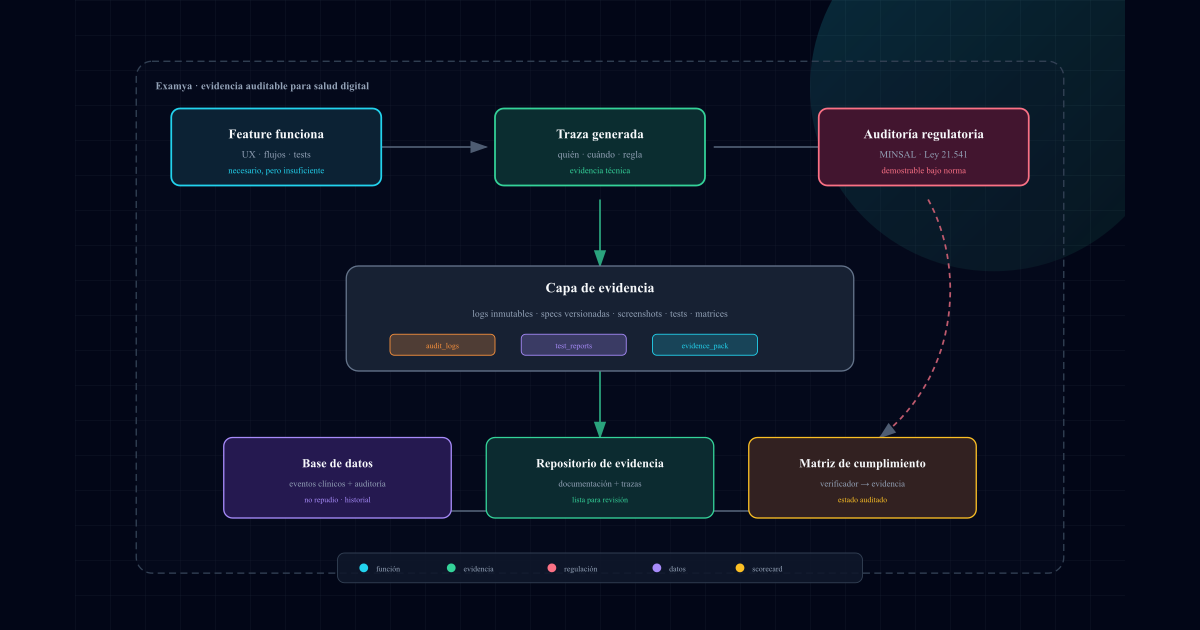
Compliance is not a feature: it's evidence
In digital health, a working feature is not enough. Without auditable traceability, it does not exist for the regulator.
Mario Inostroza
In regular software, a feature is done when the user can complete the flow.
In digital health, that is only the first floor.
If you cannot prove who did what, when it happened, under which rule, with which evidence, and what was recorded, the system may work perfectly in a demo and still be incomplete for clinical production.
That was one of the hardest lessons while reviewing compliance in Examya.
It is not enough to say: “the flow works.”
You need to prove it.
What no one tells you about compliance
The common mistake is treating compliance as a feature checklist.
- secure login,
- session timeout,
- audit logs,
- encryption,
- clinical record,
- traceability.
And yes, all of that matters. But the trap is believing each item is closed with code alone.
In digital health, a feature is not truly closed until it leaves reviewable evidence.
The architecture needs to answer uncomfortable questions:
- Where is the action recorded?
- Who can see it?
- Who can modify it?
- What happens if an auditor asks for the trace six months later?
- Is the behavior tested, or just assumed?
That is where the conversation changes.
You are no longer designing only UX. You are designing operational trust.
The real data
In the recent Examya compliance work, the learning did not come from one massive feature.
It came from looking at compliance verifiers and realizing that several components already existed, but were not always connected to formal evidence.
That nuance matters.
It was not “we need to build everything.”
It was more precise: “we need to prove it in an auditable way.”
For example, you can have a working session timeout. You can have unit tests. You can have a stable frontend hook. But if there is no clear specification, trace, screenshot, report, or explicit mapping against the verifier, the compliance position is weak.
The code does the work.
The evidence proves the work exists.
The mental architecture we used
The right way to look at it is not:
feature -> doneIt is closer to this:
feature -> event -> trace -> evidence -> verifier -> auditThat pipeline changes how you build.
Because it is no longer enough to ask “what should the system do?”.
You also need to ask:
- what should the system remember?,
- what should it be able to explain?,
- what should it be able to reconstruct?,
- what should it be able to defend during an external review?
In clinical applications, that evidence layer is not decoration.
It is architecture.
What you are really building
When you design for compliance, you are not only building screens and endpoints.
You are building an explicit relationship between operation and proof.
A clinical flow should leave something like this:
type AuditEvidence = {
  actorId: string;
  action: string;
  resourceType: 'clinical_record' | 'telemedicine_session' | 'exam_order';
  occurredAt: Date;
  ruleReference: string;
  evidenceUri?: string;
  immutableHash?: string;
};
That structure is not there to look pretty.
It is there so that, when someone asks “how do you know this happened?”, the system does not depend on human memory, loose screenshots, or good faith.
It depends on traces.
That is the difference between a system that “works” and one that can operate in a regulated clinical environment.
The gotcha: functional is not always auditable
This is the point that is hardest to accept when you come from product.
A feature can be well implemented and still not be ready for compliance.
Not because the code is bad.
Because evidence was not designed as part of the flow.
It is like building a house with solid beams, proper wiring, and a good roof, but no blueprints, permits, or structural calculations.
The house may be strong.
But when inspection arrives, you have a problem.
Digital health works the same way.
The regulator does not evaluate intention alone. It evaluates demonstrability.
Zoom out: why this matters in Chile
Chile is entering a stage where digital health can no longer operate as “fast software with a medical-looking interface.”
With interoperability, telemedicine, electronic clinical records, and new data requirements, the bar is rising.
That is good.
It forces us to build better.
But it also requires a different level of maturity: systems that not only automate tasks, but can explain their decisions, record their events, and sustain an audit.
AI in healthcare will need that foundation.
Because an agent can summarize, classify, or assist. But if the surrounding system does not leave evidence, operational risk gets hidden under a nice interface.
And in healthcare, that is not acceptable.
What comes next
In Examya, the next step is not only adding more AI capabilities.
It is continuing to strengthen the governance layer: traceability, evidence, privacy, interoperability, and operational security.
The thesis is simple:
AI can accelerate the system.
But architecture is what makes it trustworthy.
And in digital health, trust without evidence is just a promise.
📱 WhatsApp: +56962170366 🐦 X.com: @mariohealthbits 🌐 mariohealthbits.dev
Related reading
In this series
Chile now requires clinical record interoperability: why this changes everything for digital health
Law 21.668 mandates all healthcare providers in Chile to make clinical records interoperable. I analyze what this means technically, which standards are coming (FHIR, SNOMED CT, AIToF), and how Examya is preparing for this newly mandatory market.
In this series
Clinical labs: the missing piece for healthcare interoperability in Chile
We mapped 245 clinical labs from Arica to Punta Arenas. Four out of ten lack a functional digital presence. Law 21.668 will force them to interoperate in 2026. Here are the ground-level data.
In this series
FHIR + Law 21.668: How Examya Is Preparing for Chile's Mandatory Interoperability
How we're adding a FHIR layer on top of Examya's current stack (NestJS + Prisma + pgvector) to comply with Law 21.668 without rewriting anything.