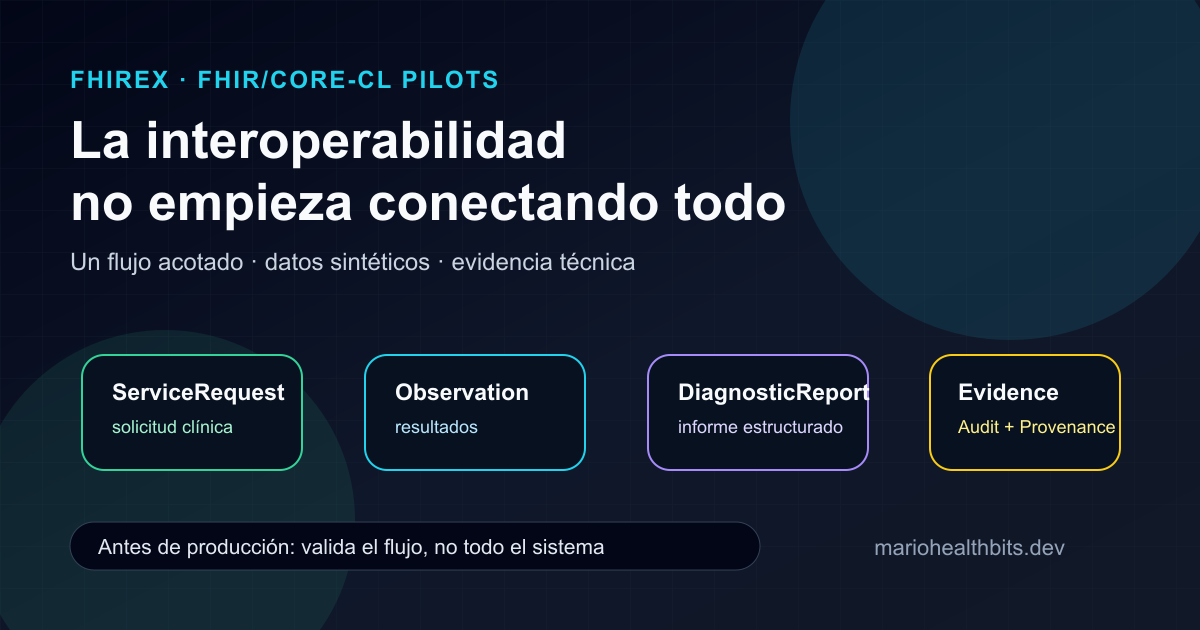
Interoperability does not start by connecting everything
Why FHIR/Core-CL pilots should start with one bounded flow, synthetic data and evidence before touching production.
Mario Inostroza
The worst way to start clinical interoperability is trying to connect the entire hospital.
It sounds ambitious. It sounds complete. It sounds like what should be done.
But in practice, it is often the perfect recipe for a project to get stuck between legacy systems, real data, ambiguous contracts, overloaded IT teams and meetings where nobody wants to own the first risk.
That is what I confirmed while reviewing recent conversations from the Chilean digital health ecosystem: everyone talks about interoperability, but the people who have to implement it need something much more concrete than a big promise.
They need a first safe case.
What nobody tells you about starting with FHIR
FHIR is not the hardest problem.
The hard problem is deciding which clinical flow is worth testing first, with what data, under which permissions, with what evidence and without breaking production.
A clinic may want to interoperate with a laboratory.
A laboratory may want to return structured results.
An IT team may want to validate whether its HIS or EHR can talk to an external service.
Medical leadership may ask for something much simpler: understand whether the flow makes clinical sense and whether it protects the patient.
Everyone is using the same word —interoperability—, but they are not asking the same question.
That is where the first mistake appears: trying to solve everything with a giant integration.
In healthcare, connecting everything on day one does not always reduce risk. Often, it increases it.
The real data behind the problem
Chile already has a strong regulatory conversation around interoperability.
Law 21.668 established the obligation to move toward interoperable clinical records. The technical ecosystem has been working for years with HL7, FHIR, Core-CL, CENS, MINSAL and communities like HL7 Chile.
But between the law, the standard and daily operations there is a large gap.
That gap appears in very concrete ways:
- exams repeated because the previous result did not arrive on time;
- referrals that lose context between primary care and hospitals;
- laboratories still delivering PDFs when the system needs data;
- IT teams that understand the value but do not want to touch production without evidence;
- physicians receiving incomplete information or receiving it too late.
In a SimpleSalud conversation, Dr. Pedro García described a very recognizable pain: the information exists, but it does not always reach the care level where it is needed. And when it does not arrive, the system repeats, waits and becomes more expensive.
That is not fixed with an architecture slide.
It is fixed by testing real flows under controlled conditions.
What we are building with Fhirex
That is why Fhirex by Examya starts from a simple idea:
You do not need to interoperate everything to learn. You need to validate one concrete clinical flow.
The approach is to run FHIR/Core-CL pilots with synthetic data before touching production.
An initial pilot can be as bounded as this flow:
ServiceRequest → Observation → DiagnosticReportThat means:
- representing a medical request as
ServiceRequest; - associating it to a synthetic patient with
Patient; - recording results as
Observation; - grouping them in a
DiagnosticReport; - leaving traceability with
AuditEventandProvenance.
That does not solve national interoperability.
But it does answer questions that matter:
- Does the FHIR contract represent the clinical flow correctly?
- Which fields are missing?
- Which codes need to be mapped?
- Which errors appear?
- What evidence does IT need?
- What can medical leadership review?
- How far are we from a production integration?
That evidence is worth more than a generic promise to “connect systems.”
The gotcha: synthetic data is not a formality
Sometimes synthetic data is discussed as if it were just a security detail.
It is not.
It is a design tool.
When you start with synthetic data, you can test structure, contracts, validations, errors and flows without bringing all production risks from day one: sensitive data, permissions, real databases, operational continuity, legal auditability and unnecessary exposure.
That changes the conversation with IT.
Instead of asking for early access to critical systems, you can say:
Let us first test whether the flow makes sense.
Let us test whether the FHIR contract works.
Let us test whether the technical evidence is enough.
Then we can talk about production.
That difference reduces friction.
And in healthcare, reducing friction is not a detail. It is what allows projects to leave the slide deck and enter the real backlog.
What I learned from watching the Connectathon
The Connectathon is a positive signal for Chile.
It shows there is community, technical energy and willingness to push real standards. But it also shows something we should not hide: implementing interoperable clinical transactions is demanding.
Teams get stressed. Contracts are interpreted differently. Systems do not always respond as expected. What looks clean in a guide appears full of edges during implementation.
That is not a criticism of FHIR.
It is a reason to start better.
A bounded pilot allows the team to learn without getting trapped in an integration that is too big to fail fast.
If the first objective is “connect everything,” every problem feels like failure.
If the first objective is “validate this flow with evidence,” every problem becomes technical learning.
Why this matters for laboratories
Clinical laboratories are a natural entry point for interoperability.
They have requests, samples, results, reports, codes, timing, traceability and relationships with multiple providers.
They also live with a clear tension: the PDF is still useful for humans, but insufficient for systems.
A physician can read a PDF.
A system needs to understand that a specific result corresponds to an observation, that the observation came from a request, that it belongs to a patient, that it was issued by a laboratory and that it can be audited.
That is where resources like ServiceRequest, Observation and DiagnosticReport stop being technical concepts and become a way to organize the clinical cycle.
Not because of love for the standard.
Because of continuity of care.
Zoom out: interoperability as risk reduction
Public conversation often presents interoperability as modernization.
I increasingly see it as risk reduction.
Risk of repeating exams.
Risk of making decisions with incomplete information.
Risk of a referral losing context.
Risk of an IT team implementing late, rushed and without evidence.
Risk of regulation arriving before internal learning.
That is why the strategy should not be waiting until everything is closed to finally move.
It should also not be connecting production on the first try.
The reasonable middle path is to run safe pilots: bounded cases, synthetic data, technical evidence, clinical review and learning before committing critical systems.
What comes next
The Fhirex page about Chile’s Interoperability Law and FHIR/Core-CL is already live:
👉 Chile’s Interoperability Law in healthcare: how to prepare with FHIR/Core-CL
The next step is to use it as support for more concrete conversations with ecosystem actors: HL7 Chile, laboratories, regional health intelligence teams and communities connected to CENS/MINSAL.
Not to sell smoke.
To validate real pains.
If an institution wants to prepare for interoperability, my recommendation is to start with a smaller question than “how do we connect everything?”
The right question is:
Which clinical flow can we validate first, with synthetic data, technical evidence and controlled risk?
That question can be answered this week.
📱 WhatsApp: +56962170366 🐦 X.com: @mariohealthbits 🌐 mariohealthbits.dev
Related reading
Recommended
Fhirex by Examya: FHIR pilots without touching production
Why we launched fhirex.examya.cl: FHIR/Core-CL pilots with synthetic data, technical evidence, and IT review before production.
Recommended
The clinical lab as a digital health API
A clinical lab already receives orders, processes samples, and returns results. The missing layer is treating it as a clinical API.
In this series
Chile now requires clinical record interoperability: why this changes everything for digital health
Law 21.668 mandates all healthcare providers in Chile to make clinical records interoperable. I analyze what this means technically, which standards are coming (FHIR, SNOMED CT, AIToF), and how Examya is preparing for this newly mandatory market.